
The Crown Without a Kingdom
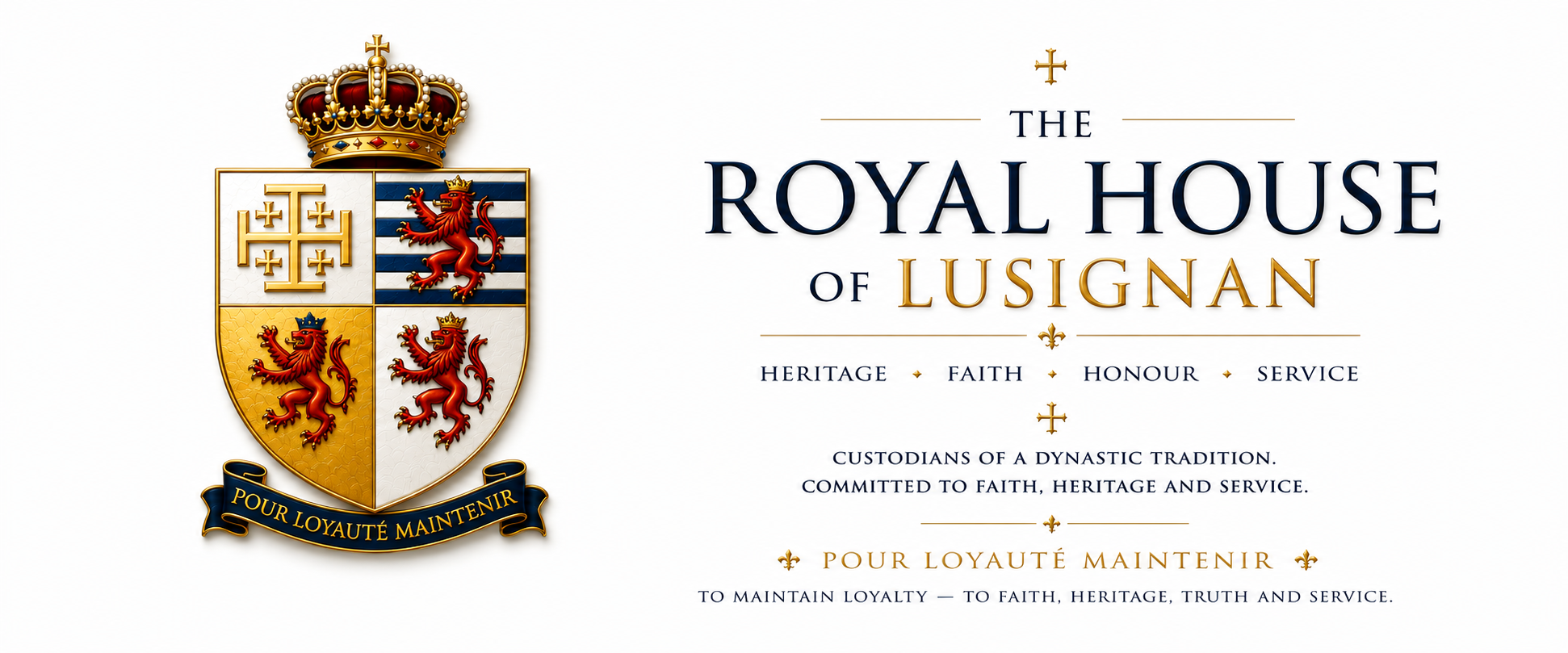
The Crown Without a Kingdom
The Dynastic Authority of the Royal House of Lusignan to Confer Royal and Noble Dignities
History, Hereditary Sovereignty, Fons Honorum and the Continuing Jurisdiction of a Royal House
There is a fundamental question which must be confronted whenever a historic royal dynasty no longer governs the territory over which its ancestors once reigned:
Does the disappearance of political sovereignty necessarily extinguish the dynasty itself—and with it every hereditary, heraldic, nobiliary and chivalric prerogative once belonging to the Crown?
In the case of the Royal House of Lusignan, the answer requires considerably more sophistication than either unquestioning acceptance or casual dismissal.
The medieval sovereignty of the Lusignans is not speculative. It is an established part of European and Levantine history. Members of the dynasty were Kings of Jerusalem, Kings of Cyprus and Kings of Armenian Cilicia. The House possessed territories, courts, noble vassals, royal heraldry and the ordinary attributes of medieval kingship. Academic scholarship treats the Lusignan monarchy of Cyprus as a genuine ruling dynasty and its institutions as those of a medieval kingdom. Peter W. Edbury’s authoritative study of the Kingdom of Cyprus devotes substantial attention both to the Lusignan dynasty itself and to the nature of Lusignan kingship and government. (Cambridge University Press)
The real question is therefore not whether the historical Lusignans were sovereign.
They unquestionably were.
The harder question is what, if anything, survived the loss of their kingdoms—and upon what basis the present Royal House of Lusignan–Kalfa Nar Bey may exercise a contemporary dynastic authority to confer titles, dignities and honours.
That question deserves to be answered carefully.
⸻
I. A Royal Dynasty Before It Was a Memory
The House of Lusignan originated among the great seigneurial families of Poitou. Medieval scholarship demonstrates that the Lusignan parentat developed into a formidable transregional aristocratic network extending across France, England and eventually the Latin East. Their influence was built upon landholding, marriage, feudal relationships and dynastic solidarity rather than retrospective invention. (OpenEdition Journals)
Their transformation from great nobles into kings came during the Crusader period.
Guy de Lusignan became King of Jerusalem in 1186 through his marriage to Queen Sibylla. Following the catastrophic defeat at Hattin and subsequent political struggles over the Jerusalem crown, Guy acquired Cyprus, where Lusignan rule became firmly established. His brother Aimery succeeded him, and the dynasty developed what would become one of the most enduring Frankish monarchies of the eastern Mediterranean. (Encyclopedia)
The Lusignan monarchy in Cyprus survived for approximately three centuries.
During this period the dynasty exercised all the normal incidents of medieval sovereignty: royal succession, feudal government, diplomacy, military command, ecclesiastical patronage, heraldic jurisdiction, honours and relationships with the nobility of Europe and the Levant.
The importance of this point should not be underestimated.
The Lusignans were not people who later claimed to have been royal.
They were royal.
Their sovereignty is part of the documentary history of medieval Europe.
⸻
II. Cyprus, Jerusalem and Armenia: Three Crowns in One Dynasty
The Lusignan royal tradition eventually came to encompass three great titles:
King of Cyprus, King of Jerusalem and King of Armenia.
The Jerusalem title survived after the permanent loss of Jerusalem itself. This fact is particularly instructive because medieval Europe did not understand the disappearance of effective territorial possession automatically to mean the immediate extinction of a royal title.
The kings of Cyprus continued to claim the kingship of Jerusalem after the Crusader kingdom on the mainland had ceased to exist. The practice is acknowledged in conventional historical reference works, which record that descendants of Aimery continued the Jerusalem claim and that the Cypriot dynasty later added the Armenian royal dignity to its titulature. (Encyclopedia)
The same phenomenon occurred following the fall of Armenian Cilicia.
In 1375, the last independent Armenian kingdom in Cilicia fell to the Mamluks. Levon V/VI de Lusignan, its last reigning king, lived thereafter in exile. Nevertheless, the Armenian royal title did not simply disappear from Lusignan dynastic consciousness. After Levon’s death, the claim was associated with the Cypriot Lusignan monarchy.
This provides an important historical precedent:
Lusignan royal titulature had already become partially non-territorial centuries before the disappearance of the Cypriot kingdom itself.
The distinction between possession of a kingdom and possession of a dynastic claim to its crown was therefore not invented in modern times. It existed within Lusignan history itself.
⸻
III. The End of Lusignan Government Was Not Necessarily the End of Lusignan Dynastic Identity
The final period of Lusignan Cyprus was complicated.
Queen Charlotte was driven from the island by her illegitimate half-brother James II. James married Caterina Cornaro. Their infant son James III died in 1474. Caterina subsequently reigned before surrendering Cyprus to Venice in 1489.
Many conventional histories accordingly speak of the Lusignan ruling dynasty ending in the fifteenth century. The Columbia Encyclopedia, for example, describes James III’s death as the end of the Lusignan dynasty in the context of the Cypriot succession. (Encyclopedia)
That statement is perfectly intelligible when referring to the reigning line of Cyprus.
It is considerably more difficult to convert it into the proposition that every genealogical descendant, collateral branch and dynastic right of the extended Lusignan family ceased to exist at precisely the same moment.
Medieval royal families were rarely confined to the king and his immediate children. Cadet and collateral branches mattered enormously. Claims could move laterally through siblings, cousins, legitimised descendants, female-line descendants and branches established abroad.
The Royal House’s modern genealogical case rests upon precisely this distinction.
Its records trace descent and collateral succession through members of the extended Cypriot family and subsequent European and Eastern branches rather than arguing that James III secretly produced descendants.
The House’s own genealogical reconstruction traces the present succession through branches associated with the princes of Galilee and later French and Russian Lusignan lines before reaching the Kalfa Nar Bey family. That reconstruction explicitly acknowledges several difficult transitions in the genealogy rather than pretending that the succession from the fifteenth century to the nineteenth is uncomplicated.
That candour is important.
Historical legitimacy is not strengthened by concealing disputed evidence.
It is strengthened by identifying precisely where the evidence is strongest, where it is circumstantial and where further archival examination remains warranted.
⸻
IV. The Importance of the Kalfa Nar Bey Recognition
The most significant event in the modern Lusignan succession argument occurred in 1878.
The Kalfa Nar Bey brothers—among them Archbishop Khoren and Ambroise-Guy—asserted descent from a collateral branch of the Lusignan family. According to the House’s genealogical records, their position was strengthened by a Letter of Recognition issued in May 1878 by Prince Louis Christian de Lusignan, who was regarded by them as head of the senior family branch.
The House’s current family tree itself records that the Kalfa claim was contested, including by other Lusignan claimants, and that litigation contemplated in Paris did not ultimately produce a judicial resolution of the dynastic controversy.
That fact must not be hidden.
It should instead be properly understood.
A court declining to determine a dynastic controversy is not equivalent to a judicial finding that the ancestry was fraudulent. Equally, an internal family recognition is not automatically equivalent to recognition by a modern state.
The legal and historical significance of the 1878 recognition lies elsewhere.
If Louis Christian was the legitimate senior dynast and if his recognition of the Kalfa Nar Bey relationship was valid under the applicable dynastic law, then the document potentially serves as an act of intra-dynastic recognition—an acknowledgement by the contemporary head or senior member of the dynasty that a collateral family belonged to the same royal house.
The present Head of the House, Prince Louis de Lusignan, describes precisely this conception of continuity: a Cypriot-derived family which survived in the Ottoman world, later reconnected with European branches and transmitted its dynastic identity through successive generations. He additionally attributes historical confirmations of his family’s position to Ottoman, French, Italian and Russian sovereign authorities.
Those claimed historical recognitions deserve continuing archival authentication. But the existence of an identifiable nineteenth-century Lusignan revival is beyond serious question.
⸻
V. The Russian and European Dimension
A particularly significant figure in this modern history was Louis Christian de Lusignan (1808–1884).
The House’s genealogical materials describe him as a Russian Imperial Army colonel, a member of the French-Russian Lusignan succession, and a dynast whose position received recognition within Imperial Russia and Napoleonic France. They also record his son, Michael David de Lusignan, as another recognised bearer of Lusignan princely status.
This matters because the nineteenth-century Lusignan phenomenon was not merely the appearance of an invented surname in isolation.
There were multiple persons publicly using Lusignan identity and princely titulature, interacting with European aristocratic society and disputing amongst themselves the correct succession.
Ironically, the existence of competing claimants is itself evidence of something important.
It demonstrates that there was a live nineteenth-century dynastic question.
It does not prove which claimant was correct, but neither is it consistent with the simplistic proposition that nobody regarded a continuing Lusignan identity as possible until very recent times.
⸻
VI. What Is Fons Honorum?
At the centre of any discussion concerning the conferral of nobility lies the concept traditionally described as fons honorum—the “fountain of honour.”
Historically, honours flowed from sovereign authority.
A king or sovereign prince could create nobility, confer dignities, institute orders, regulate heraldry and reward service because such powers formed part of the sovereign prerogative.
That proposition remains visible even in modern constitutional monarchies.
In the United Kingdom, for example, titles and honours remain fundamentally connected with the Royal Prerogative. The House of Commons Library explains that the Monarch bestows many titles and honours through prerogative instruments such as Letters Patent and Royal Warrants. (House of Commons Library)
The medieval Lusignan kings possessed this power not because somebody later granted it to them, but because they were sovereign rulers.
Consequently, the historic Lusignan Crown was unquestionably a fons honorum during the period of its sovereignty.
The more controversial issue concerns whether some component of that authority can survive in the head of a formerly sovereign dynasty.
⸻
VII. The Doctrine of the Non-Reigning Royal House
European dynastic tradition has long distinguished between:
1. a reigning sovereign;
2. a formerly reigning sovereign or dynasty;
3. a pretender to a throne;
4. an ordinary noble family; and
5. a private association simply adopting royal terminology.
These categories should never be treated as interchangeable.
A historically sovereign House which loses its throne does not thereby become historically equivalent to a club founded yesterday.
The International Commission for Orders of Chivalry, an influential though non-governmental authority in the study and classification of chivalric institutions, articulates a traditional dynastic doctrine according to which family or House Orders belonging jure sanguinis to former sovereign houses may retain dynastic and chivalric validity following political loss of sovereignty. Its principles distinguish such institutions from newly invented private orders and connect their authority to an historically established sovereign House. (ICOC)
That doctrine is particularly well developed in relation to unquestionably deposed European Houses such as Bourbon-Two Sicilies, Savoy and other former ruling dynasties whose family orders continued after loss of political power. The Commission’s register continues to categorise a number of such institutions as dynastic orders. (ICOC)
This does not, however, establish the proposition that every person claiming descent from a medieval monarch automatically becomes a sovereign prince.
Nor does it establish that every title created by a non-reigning dynasty must be recognised by every modern state.
The proper principle is narrower.
If a claimant can establish legitimate succession to the headship of an historically sovereign House under that House’s dynastic law, there exists a substantial traditional argument that certain internal dynastic prerogatives may continue even though the House no longer exercises territorial sovereignty.
That is the juridical space within which the contemporary Royal House of Lusignan operates.
⸻
VIII. Jure Sanguinis: Authority by Dynastic Succession
The central principle underlying a hereditary royal House is jure sanguinis—right derived through dynastic descent.
A reigning king’s authority historically combined two things:
public territorial sovereignty and personal dynastic capacity.
The first concerns governing a state.
The second concerns his position as head of a family and dynasty.
When a monarchy falls, the public governmental component can plainly disappear. The former ruler no longer legislates for the population, collects taxes, commands the national army or exercises territorial jurisdiction.
But family headship is different.
The dynasty may continue.
Its archives may continue.
Its genealogy may continue.
Its house law may continue.
Its armorial identity may continue.
Its family orders may continue.
And the position of head of that family may continue to be inherited.
This distinction explains why descendants of former reigning families throughout Europe continue to bear historic dynastic titles socially and genealogically even where they possess no governmental authority whatever.
The Royal House of Lusignan’s argument should therefore not be:
“We still govern Cyprus.”
It plainly does not.
The stronger argument is:
“We claim continuation of the historically sovereign dynasty and exercise those hereditary and internal dynastic prerogatives which are capable of surviving the loss of territorial government.”
That distinction changes the entire debate.
⸻
IX. Dynastic Authority Is Not Territorial Sovereignty
This is perhaps the most important legal qualification.
The present Royal House of Lusignan is not the Government of the Republic of Cyprus.
It does not claim legislative jurisdiction over Cyprus.
It does not confer citizenship.
It does not possess diplomatic sovereignty comparable with a recognised state.
It does not create peerages of the United Kingdom, France, Italy or any other modern republic or monarchy.
Its titles must therefore be understood as dynastic titles granted within the jurisdiction and tradition of the Royal House of Lusignan.
This is not a weakness.
It is an essential clarification.
Modern states determine for themselves what foreign titles they legally recognise. British practice illustrates this vividly. Current UK passport guidance distinguishes British peerages from foreign titles and notes that a foreign title will not ordinarily appear in a British passport as a recognised title without the appropriate Royal Warrant, even where the individual legitimately possesses that foreign title. (GOV.UK)
Likewise, UK rules governing foreign honours restrict formal acceptance and wearing of foreign state awards and international awards in particular circumstances. (GOV.UK)
The lesson is simple:
Validity within one system and recognition within another system are not the same question.
A House may consider a person Duke, Count, Baron or Knight according to its own dynastic statutes while a modern republic may accord that dignity no public-law effect.
That does not automatically render the dignity fraudulent.
It means only that the title belongs to a different juridical category.
⸻
X. The Three Levels of Nobiliary Legitimacy
A great deal of unnecessary controversy can be avoided by distinguishing three different propositions.
1. Historical Legitimacy
Was the authority from which the tradition derives historically sovereign?
For the House of Lusignan the answer is unquestionably yes.
The House ruled Jerusalem, Cyprus and Armenian Cilicia and belonged among the established royal dynasties of medieval Christendom. (Cambridge University Press)
2. Dynastic Legitimacy
Has the historical House survived through a genealogically and constitutionally credible succession to a modern Head of the House?
For the current Royal House of Lusignan–Kalfa Nar Bey, this is the principal question upon which its contemporary authority depends.
The House maintains an extensive genealogy connecting the present line with the historical dynasty through Cypriot, French, Russian and Kalfa Nar Bey branches; it also identifies nineteenth-century acts of recognition and subsequent transmission.
The House itself recognises that portions of this succession have historically been contested.
Accordingly, this is properly characterised not as an uncontested fact accepted by every genealogist, but as a documented dynastic claim supported by an internal body of genealogical evidence and historical acts of recognition which remains open to external scholarly examination.
3. Civil Recognition
Does a particular modern state recognise a Lusignan-conferred title for purposes of passports, civil status, precedence or law?
That depends entirely upon the law of the jurisdiction concerned.
No responsible Royal House should suggest otherwise.
A person receiving a Lusignan noble dignity should therefore understand that the honour is dynastic, not a governmental office or a peerage of the recipient’s country of citizenship unless that country separately recognises it.
⸻
XI. Why the Power to Confer New Dignities Requires More Care Than the Right to Bear Old Ones
There is another distinction often overlooked.
It is comparatively easy to defend the continued use of inherited family titles by descendants of a former sovereign dynasty.
The creation of new noble dignities, however, raises the higher question of whether the ancient jus honorum itself survived deposition.
Traditional dynastic jurisprudence answers that in at least some circumstances it can.
But this is not a universally codified proposition of modern international law.
There is no global treaty declaring:
“Every descendant of every deposed king may create nobility.”
Nor should such a rule be imagined.
The better case requires several cumulative elements:
historical sovereignty; identifiable dynastic continuity; lawful headship; continuing house law; genuine exercise of dynastic jurisdiction; and consistency between the dignity conferred and the traditions of the House.
The closer a House approaches these criteria, the stronger its claim to possess surviving dynastic honour rights.
The further it departs from them, the more its titles resemble purely private honorifics.
The Royal House of Lusignan therefore benefits from treating its titulary practice not as unlimited sovereign power, but as a carefully regulated hereditary jurisdiction of the House.
⸻
XII. The House’s Own Practice Supports an Institutional, Rather Than Merely Personal, Model
The modern Royal House does not describe its authority as something invented anew by its current Head.
Its internal transmission documents place the Head of the House within a succession of Grand Masters and dynasts extending through the historic kings and subsequent titular heads of the dynasty. The House’s Charter of Transmission for the Order of the Sword, for example, records the medieval royal succession, the post-territorial titular succession and the later Kalfa Nar Bey Grand Masters, ending with Prince Louis George de Lusignan.
Prince Louis likewise describes the Grand Masterships of the House’s principal dynastic Orders as hereditary offices associated with family seniority, while recognising the possibility of future constitutional arrangements where succession circumstances require them.
This institutional approach matters.
A legitimate hereditary system should not depend entirely upon the whim of one person.
It should possess:
* a recognised Head of House;
* rules of succession;
* archives;
* registers;
* decrees and letters patent;
* defined grades of nobility;
* heraldic regulation;
* procedures for creation and transmission;
* mechanisms for revocation;
* standards of conduct; and
* continuity beyond the lifetime of the current head.
The greater the constitutional discipline of the House, the stronger its claim to be exercising dynastic jurisdiction rather than theatrical self-styling.
⸻
XIII. Letters Patent: The Proper Instrument of a Dynastic Grant
Where the House grants a noble dignity, the instrument should therefore make its nature perfectly clear.
A properly formulated Lusignan Letters Patent should establish:
who confers the dignity;
the capacity in which it is conferred;
the dynastic authority from which that capacity derives;
whether the title is personal or hereditary;
the applicable succession rule;
whether a territorial designation is historical, nominal or symbolic;
whether arms accompany the dignity;
the place of the grantee within the House’s nobiliary register;
and
the limitations upon the recognition of the title outside the jurisdiction of the House.
Such precision protects both the House and the recipient.
It also separates legitimate dynastic titulature from the notorious commercial practice of selling meaningless “lordships” accompanied by extravagant claims of legal status.
The distinction is substantial.
A Lusignan title should not be represented as ownership of foreign territory, a governmental office, diplomatic status or a modern state peerage.
It is a dignity within a continuing royal and nobiliary tradition.
⸻
XIV. Noble Titles Are Not Commodities
This principle deserves particular emphasis.
If the House wishes its nobiliary authority to command serious respect, titles should never appear to be retail products.
Historically, nobility represented a relationship between sovereign authority, service, family, responsibility and honour.
Money alone cannot create nobility.
Administrative fees, chancery costs, charitable contributions or traditional oblations can exist within honour systems. But the dignity itself should be conferred because the Head of the House judges the recipient worthy of incorporation into the nobiliary structure of the dynasty.
The difference is the difference between:
a grant associated with service
and
a product purchased from a catalogue.
The Royal House’s credibility will increase, not diminish, by insisting upon this distinction.
⸻
XV. Nobility as Membership in the Dynastic Community
Properly understood, the creation of a Lusignan Duke, Marquis, Count, Viscount or Baron does not mean that a medieval feudal estate has miraculously reappeared.
Nor does it imply political superiority over other citizens.
Rather, the dignity represents a person’s formal incorporation into the nobiliary household and honour system of the dynasty.
It is therefore relational.
A Lusignan Duke is a Duke of or within the Royal House of Lusignan, according to the terms of the grant.
A Lusignan Baron is a Baron according to Lusignan dynastic law.
The authority of the title flows from the authority of the House.
This is analogous in principle to the way that membership, rank and dignity within historic dynastic orders flow from the headship of the dynasty rather than from the civil government in which the recipient happens to live.
⸻
XVI. Recognition by Other Royal Houses: Useful but Not Constitutive
Recognition by other dynasties can strengthen a House’s social and dynastic standing.
The modern Lusignan documentation records relationships and recognitions involving other princely families and identifies royal patronage associated with its chivalric institutions. Its records include, among others, relationships involving members of the House of Savoy and Bagrationi-associated dynasts.
Such relationships can be evidentially important.
But they should not be exaggerated.
One prince recognising another prince does not create medieval ancestry where none exists.
Nor does a photograph with a reigning monarch establish royal succession.
Recognition is best understood as corroboration of social or dynastic standing, not a substitute for genealogy.
The foundation must always remain documentary continuity.
⸻
XVII. The Argument from Historical Extinction Must Be Treated Carefully
Critics frequently state that the House of Lusignan became extinct in the fifteenth or seventeenth century.
Sometimes this is an entirely reasonable statement depending upon which branch is being discussed.
The original agnatic Poitevin lines, the reigning Cypriot line and various collateral branches ended at different dates.
The term “extinct” is therefore dangerously imprecise unless the writer specifies:
Which branch?
In what line?
Agnatic or cognatic?
Reigning or genealogical?
Legitimate only or including legitimised/collateral descendants?
Extinct as territorial rulers, or extinct biologically?
Modern scholarship itself recognises the complexity of speaking broadly of Lusignan extinction. A scholarly review of Clément de Vasselot de Régné’s major study of the Lusignan family notes how problematic it is to speak of the family entering extinction while eastern Lusignan branches remained politically active. (OpenEdition Journals)
The modern Lusignan claim therefore deserves to be evaluated genealogically, generation by generation, rather than dismissed through the rhetorical use of a single extinction date.
⸻
XVIII. The Proper Scholarly Position on the Modern Lineage
A serious institutional history should avoid two opposite errors.
The first is sceptical absolutism:
“The medieval kingdom ended; therefore nobody today can possibly be related to or continue the dynasty.”
That does not follow genealogically.
The second is dynastic absolutism:
“The House says the lineage exists; therefore every claimed generation and recognition must be accepted as proven.”
That does not follow either.
The responsible conclusion is stronger because it is more precise:
The historical sovereignty of the medieval House of Lusignan is indisputable.
A documented modern Lusignan tradition demonstrably existed by the nineteenth century.
The Kalfa Nar Bey family publicly asserted Lusignan dynastic status during that period and possessed relationships with other persons using Lusignan princely identity.
The present House maintains a specific genealogy and succession doctrine connecting those nineteenth-century dynasts to medieval Lusignan branches.
Elements of that genealogy have been contested historically and therefore merit continuing archival verification rather than concealment.
And finally:
If the succession asserted by the present House is established according to the applicable dynastic law, the resulting claim to continuing internal dynastic prerogatives becomes substantially stronger.
That is an intellectually defensible position.
⸻
XIX. What the Royal House of Lusignan Can Legitimately Claim
The Royal House can state with exceptional confidence that it inherits and preserves the history, identity, heraldic tradition and dynastic memory of one of medieval Christendom’s great royal families.
Subject to the continuing substantiation of its modern genealogy and succession, it can additionally maintain that its Head exercises a surviving dynastic rather than territorial jurisdiction.
Within that jurisdiction, the House may assert the power to:
create and regulate internal dynastic dignities;
recognise and confirm inherited family distinctions;
confer personal and hereditary noble titles according to House law;
grant armorial bearings subject to its own heraldic jurisdiction;
appoint officers of the Royal Household;
confer honours and decorations;
exercise grand mastership of those dynastic Orders whose legitimate transmission to the House can be demonstrated;
issue Letters Patent and decrees;
maintain registers of nobility and chivalry;
and regulate the precedence and succession of dignities created within the House.
What it should not claim is equally important.
Such grants do not automatically create nobility recognised by the Republic of Cyprus, the French Republic, the United Kingdom, Australia or another sovereign state.
They do not create diplomatic immunity.
They do not confer citizenship.
They do not convey ownership of the geographical territory used in a title.
They do not constitute public office.
And they do not permit a recipient to misrepresent the title as having been conferred by their national government.
These limitations do not destroy dynastic authority.
They define it.
⸻
XX. The Lusignan Case Is Ultimately a Question of Continuity
The strongest defence of the Royal House of Lusignan does not depend upon pretending that the political world of 1398 still exists.
It plainly does not.
Nor should legitimacy be founded upon extravagant theories suggesting that medieval sovereignty somehow gives a present dynasty jurisdiction over citizens of modern Cyprus, Armenia or Israel.
It does not.
The real case is both narrower and more compelling.
Royal Houses are historical legal and familial institutions as well as former governments.
Governments may disappear while families survive.
Territories may be conquered while succession continues.
Crowns may cease to be exercised politically while royal identity remains part of the patrimony of a dynasty.
Chivalric and heraldic institutions may survive the states in which they originated.
Former reigning families may continue to regulate their own members, family orders and dynastic affairs long after losing governmental power.
The question is consequently not whether the present House possesses the same sovereignty enjoyed by King James I of Cyprus.
It does not.
The question is whether some portion of the historic honour jurisdiction of that royal dynasty can survive through lawful dynastic succession.
European dynastic tradition supplies a respectable basis for answering that question in the affirmative where continuity and lawful headship can be demonstrated.
⸻
XXI. The Case for the Present Royal House
Applied specifically to the Royal House of Lusignan–Kalfa Nar Bey, the case rests upon several interconnected foundations.
First stands the undisputed historical sovereignty of the medieval House of Lusignan.
Second stands the existence of multiple collateral Lusignan branches after the principal reigning lines ceased to govern.
Third stands the nineteenth-century documentary emergence of a continuing Lusignan princely tradition, including Louis Christian de Lusignan and competing branches claiming succession.
Fourth stands the 1878 recognition upon which the Kalfa Nar Bey branch substantially relies.
Fifth stands the subsequent transmission of the Kalfa Nar Bey dynastic identity through identifiable generations to the present Head of the House.
Sixth stands the continuing institutional exercise of House functions through constitutions, decrees, chivalric Orders, appointments, letters patent, heraldry and organised priories.
Seventh stands the established European concept that the internal dynastic identity of a formerly sovereign House may survive loss of territorial rule—a principle visible in the continued existence of numerous formerly reigning European dynasties and their family institutions. (ICOC)
Taken together, these elements provide a substantial basis upon which the Royal House can understand and articulate its authority.
⸻
XXII. Legitimacy Must Be Preserved Through Restraint
There is one final principle upon which the future reputation of the House may depend more than any other.
Dynastic legitimacy is strengthened by restraint.
A Royal House confident in its history need not claim powers which modern law plainly denies it.
It need not pretend to be a government.
It need not describe private recognition as diplomatic recognition.
It need not convert every historic tradition into an unqualified statement of legal fact.
It need not conceal scholarly disagreement.
And it certainly need not manufacture history where documentation is incomplete.
Its dignity lies precisely in the opposite approach.
The Royal House of Lusignan can say:
Our ancestors were sovereign.
That is history.
We maintain that their dynasty survives through our lineage and succession.
That is the dynastic claim.
We preserve the House’s honours, heraldry, traditions and chivalric institutions.
That is the contemporary function.
We confer noble dignities under our House law rather than pretending to confer governmental peerages of modern states.
That is the jurisdictional distinction.
We invite serious archival scholarship concerning our genealogy rather than fearing it.
That is institutional confidence.
This formulation is far more formidable than an assertion of imaginary territorial sovereignty.
⸻
Conclusion
A Living Dynastic Jurisdiction
The Royal House of Lusignan occupies an unusual position at the intersection of medieval history, genealogy, dynastic tradition, chivalric law and modern private nobiliary practice.
Its medieval sovereignty is beyond reasonable dispute.
Its historical importance to Jerusalem, Cyprus and Cilician Armenia is well established.
Its transition from reigning monarchy into a non-territorial dynastic tradition is considerably more complicated and must be examined through the evidence of collateral succession, nineteenth-century recognition, family documentation and the Kalfa Nar Bey lineage.
The resulting modern authority should therefore be described accurately.
The present Royal House does not claim the public governmental sovereignty of the historic Kingdom of Cyprus.
Rather, it claims to constitute the continuing dynastic embodiment of the formerly sovereign House of Lusignan.
From that position arises the asserted jus honorum: the surviving dynastic right of the Head of the House to regulate the internal honour system of the dynasty and, according to House law, to confer dignities, nobiliary titles, heraldic distinctions and chivalric honours.
Such titles possess their primary validity within the dynastic jurisdiction which created them.
Recognition by contemporary states is a separate matter governed by their respective domestic laws.
This distinction is not merely legal caution.
It is the very foundation upon which a credible twenty-first-century Royal House should stand.
For ultimately a dynasty is not made legitimate by the magnificence of its titles.
Titles derive legitimacy from the dynasty.
And the legitimacy of a dynasty rests upon history, lineage, lawful succession, institutional continuity and honourable conduct.
For the Royal House of Lusignan, the task of the present generation is therefore not to recreate a vanished medieval state.
It is something more enduring:
to preserve the patrimony of the Crown;
to document the lineage with scholarly rigour;
to maintain the integrity of its House law;
to confer honours with discretion rather than commerce;
and to ensure that every dignity granted in the Lusignan name remains worthy of the kings from whom that name descends.
A kingdom may be lost.
A throne may stand empty.
Political sovereignty may pass to another age.
But where lawful descent, memory, institutions and dynastic identity endure, the heritage of a Royal House need not disappear with the territory over which its ancestors once reigned.
The Crown as government may belong to history.
The House—and the honour entrusted to it—may yet remain.
Pour Loyauté Maintenir.”
HH Duke Gregory J Fellows
Prince of Blanchegarde
Marshal of The Royal House of Lusignan
