
The Royal House of Lusignan
Preserving a Royal Heritage with Scholarship, Integrity and Service
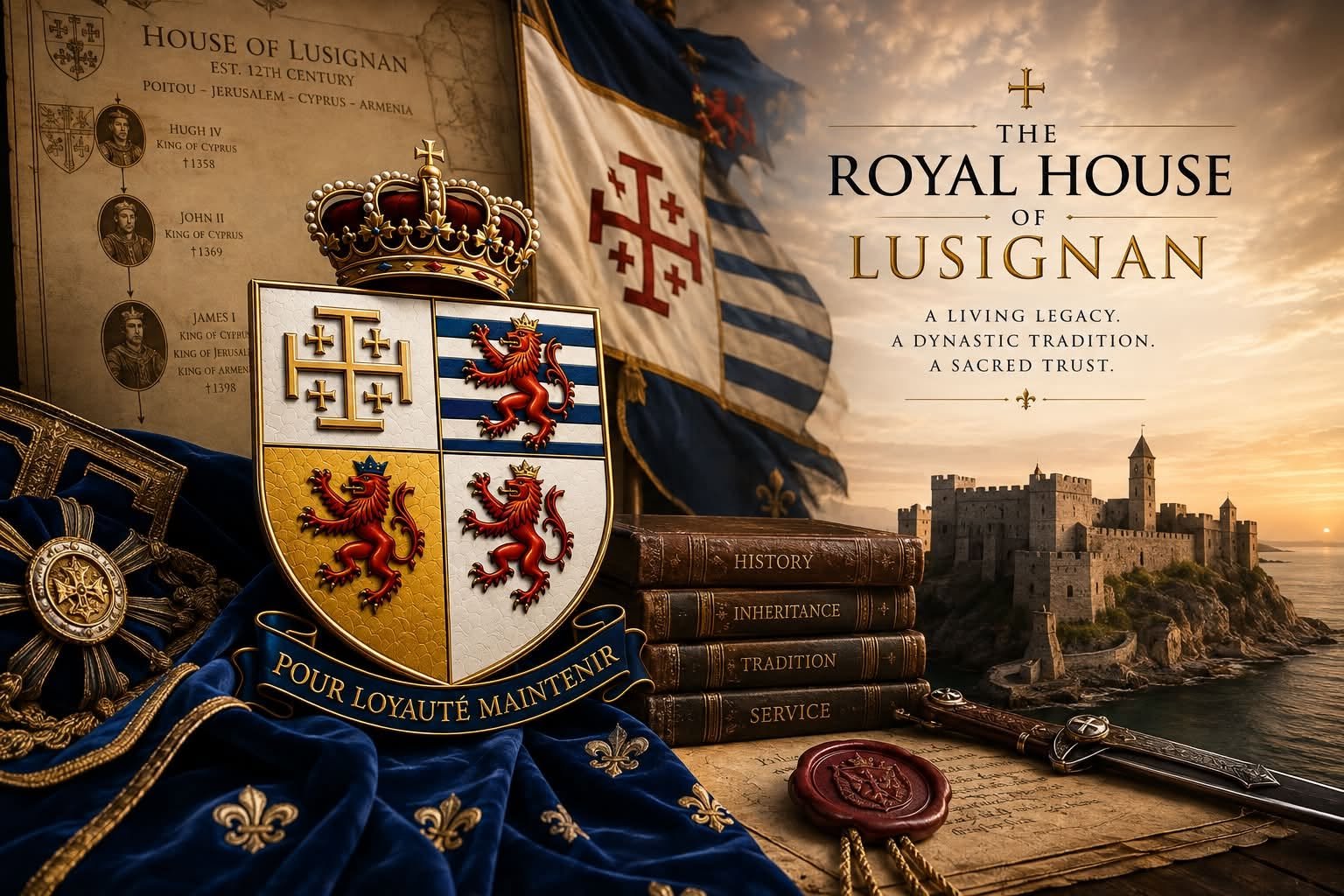
From medieval Poitou to Jerusalem, Cyprus and Cilician Armenia, the Lusignan name belongs to one of the remarkable dynastic histories of the medieval Mediterranean.
The contemporary Royal House of Lusignan preserves a claimed dynastic tradition associated with that historic House and with the later Lusignan–Kalfa Nar Bey succession.
We distinguish carefully between the established history of the medieval dynasty, the documented history of later Lusignan claimants, and those elements of the modern genealogical succession that remain subjects of historical investigation and debate.
We believe a historic inheritance is best honoured not by avoiding difficult questions, but by examining them.
Heritage is an inheritance. Truth is its safeguard. Service is its obligation.
Explore the History
The Contemporary House
Genealogy & Evidence
A Dynasty of the Medieval Mediterranean
The medieval House of Lusignan emerged from Poitou in western France and became one of the significant aristocratic families of medieval Europe and the Latin East.
Members of the family became associated with the Crown of Jerusalem and established a dynasty in Cyprus that endured for generations. A branch of the family later ascended the throne of the Armenian Kingdom of Cilicia.
These chapters of Lusignan history are well established in medieval chronicles, archival records and modern academic scholarship.
They constitute the historical foundation from which the contemporary House draws its identity and inspiration.
Discover the Medieval Dynasty
The Contemporary Royal House
The institution known today as the Royal House of Lusignan preserves the Lusignan–Kalfa Nar Bey dynastic tradition and recognises Prince Louis George de Lusignan Kalfa Nar Bey, styled within the House as His Royal Highness, as its present Head.
The later genealogy connecting the contemporary succession with the medieval dynasty has a complex history.
Some elements are supported by identifiable historical records and nineteenth- and twentieth-century sources. Other generational connections remain disputed or require further archival verification.
The House therefore presents its continuity as a dynastic claim supported by an inherited genealogical tradition and an evolving body of documentary evidence, rather than asking readers to regard every link as beyond historical question.
Our archives and research programme exist to strengthen that evidence wherever possible.
Examine the Dynastic Succession
Read Our Statement of Historical Position
What We Claim — and What We Do Not
The contemporary Royal House regards itself as the custodian of a continuing Lusignan dynastic tradition.
It does not claim governmental or territorial sovereignty over Cyprus, Jerusalem, Armenia, France or any other modern state or territory.
It is not a government in exile and does not issue citizenship, passports, diplomatic status or public authority.
The term Royal House reflects the institution's claimed dynastic identity and relationship to the historic Lusignan monarchy. Historical styles, titles and dignities used within the House are maintained within its own dynastic and ceremonial tradition and should not be interpreted as possessing automatic civil recognition in any particular country.
Where external recognition exists, the House seeks to identify its nature and source accurately.
Where it does not exist, we do not claim it.
Read Our Status & Governance Statement
Heritage with Evidence
The Royal House is committed to separating four things that are too often confused in dynastic history:
Documented historical fact
Reasoned historical interpretation
Inherited dynastic tradition
Unresolved or disputed claims
Our published research identifies those distinctions wherever practicable.
We welcome responsible scrutiny by historians, genealogists, archivists and specialists in heraldic and chivalric history.
Evidence that strengthens our tradition deserves publication.
Evidence that qualifies it deserves equal attention.
Because historical integrity is not a threat to heritage.
It is what makes heritage worth preserving.
Visit the Research & Archives Centre
Chivalry in the Modern Age
The contemporary House maintains four chivalric institutions and traditions:
The Order of the Sword of Cyprus or Silence
The Order of Saint Catherine of Mount Sinai
The Order of Saint Blaise
La Croix de l’Ordre Asiatique
Their respective histories are not identical.
Some draw upon documented medieval institutions or traditions; others have later histories of foundation, revival, transmission or incorporation into the contemporary House.
For that reason, each Order is presented according to its own documentary history, including its claimed origin, earliest verified evidence, later development and present constitutional status.
These Orders are maintained within the dynastic tradition of the contemporary Royal House. They are not presented as state honours and do not of themselves confer civil nobility, citizenship, diplomatic privilege or governmental authority.
Where an Order does not possess recognition from an external civil or ecclesiastical authority, no such recognition is implied.
For us, modern chivalry must ultimately be demonstrated through:
Faith · Honour · Integrity · Charity · Courage · Service
Explore the Four Orders
Our Purpose
The work of the contemporary Royal House is directed toward five enduring responsibilities.
Historical Preservation
To preserve documents, genealogy, heraldry, artefacts and the cultural memory associated with the Lusignan tradition.
Scholarship
To encourage rigorous historical and genealogical investigation, including research into disputed aspects of the later succession.
Christian Service
To express the Christian inheritance of the House through compassion, charitable action and respect for others.
Chivalric Formation
To encourage personal conduct founded upon honour, responsibility, loyalty, mercy and service.
Stewardship for the Future
To transmit the Lusignan heritage to future generations with greater knowledge, stronger governance and deeper integrity.
Membership Means Service
Membership of the contemporary House and its chivalric institutions is understood as a responsibility rather than a commodity.
Admission is subject to the constitutions, eligibility requirements and approval processes of the relevant institution.
Membership, honours, ranks and dignities are not purchased.
Application, sponsorship, administrative fees or charitable donations do not guarantee admission, promotion, decoration, noble dignity or advancement.
The value of membership should ultimately be measured not by the insignia a person wears, but by the character and service that membership inspires.
Membership & Service
Governance and Transparency
The contemporary Royal House is committed to accountable modern administration alongside the preservation of historical tradition.
Visitors may consult information concerning:
The Head of the House
The Royal and Governing Councils
Constitutions and governing principles
Legal and administrative structure
Dynastic succession
Historical claims and supporting evidence
The status of the Chivalric Orders
Membership principles
Charitable and cultural activities
Our intention is straightforward:
to make clear what is history, what is tradition, what is claimed, what is documented and what remains to be established.
Governance & Transparency
Pour Loyauté Maintenir
To Maintain Loyalty
Loyalty to faith.
Loyalty to heritage.
Loyalty to truth.
Loyalty to service.
The medieval Lusignans left an extraordinary historical inheritance.
The responsibility of the contemporary House is not to enlarge that inheritance through mythology, but to preserve it with dignity, investigate it with courage and translate its finest ideals into meaningful service.
THE ROYAL HOUSE OF LUSIGNAN
Heritage · Scholarship · Integrity · Service

-
![A medal with a starburst design featuring blue and gold colors, a circular center with a dollar sign and 'S' symbol, and small metallic balls at the tips of the star points.]()
Order of the Sword
-
![A detailed heraldic crest featuring a crown, blue drapes, and a shield with various symbols including swords, a wheel, and angels, with a banner reading 'Pour l'honneur et la patrie' at the bottom.]()
Orders of Saint Catherine of Mount Sinai
-
![The badge of the French police force, featuring a silver star shape with a golden cross and a blue circular emblem in the center, inscribed with 'LA CROIX DE L'ORDRE ASIATIQUE'.]()
La Croix de L’Ordre Asiatique
-
![A coat of arms featuring a shield with a red cross and a small statue, topped with a lion's head and crowned, with a chain and a cross hanging below.]()
Order of Saint Blaise



Contact Us
Interested in learning more about The House of Lusignan and the Chivalric Orders of Saint Catherine of Mount Sinai, The Order of Saint Blaise, La Croix de L’Ordre Asiatique and The Order of the Sword - of The House of Lusignan?