
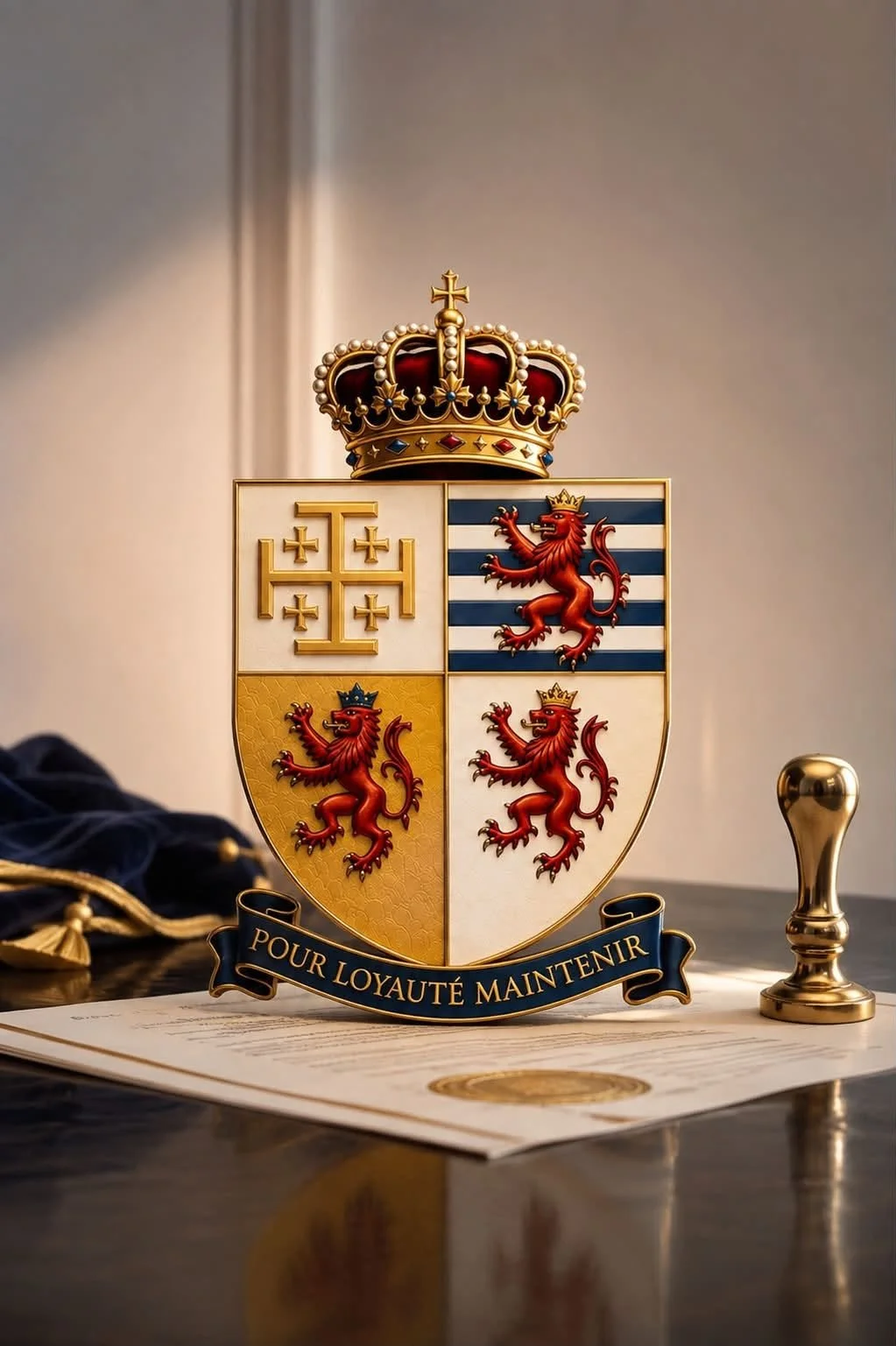
The Crown Without a Kingdom
The Dynastic Authority of the Royal House of Lusignan to Confer Royal and Noble Dignities
History, Hereditary Sovereignty, Fons Honorum and the Continuing Jurisdiction of a Royal House
There is a fundamental question which must be confronted whenever a historic royal dynasty no longer governs the territory over which its ancestors once reigned:
Does the disappearance of political sovereignty necessarily extinguish the dynasty itself—and with it every hereditary, heraldic, nobiliary and chivalric prerogative once belonging to the Crown?
In the case of the Royal House of Lusignan, the answer requires considerably more sophistication than either unquestioning acceptance or casual dismissal.

The House of Lusignan
The House of Lusignan is a royal house of French origin, which at various times ruled several principalities in Europe and the Levant, including the kingdoms of Jerusalem, Cyprus, and Armenia, from the 12th through the 15th centuries during the Middle Ages. It also had great influence in England and France.
The family originated in Lusignan, in Poitou, western France, in the early 10th century.